
Why Cases Matter
How PracticeRunner organizes individual, couple, family, group, and consultation work around the relationship or service being provided, not only around one client record.
Why Cases Matter
Most practice management systems start with a simple assumption: one client receives care, attends appointments, signs documents, receives invoices, and pays bills.
That works for many individual therapy cases.
It starts to fit less well when the clinical work is organized around a relationship, a family system, a group, or professional consultation service. Couples therapy, family therapy, parent-child work, individual consultation, consultation groups, and process groups often need more than a single-client record with extra people attached.
PracticeRunner uses cases to represent the clinical relationship being treated.
What a case is
PracticeRunner uses cases to organize the work you do. A case might be an individual client, a couple, a family, a therapy group, an individual consultation, or a consultation group.
In the app, PracticeRunner uses the most natural name for the type of work you are viewing, such as client, couple, family, group, consultation client, or consultation group, while keeping everything organized under Cases.
It may be:
- an individual client
- a couple or other two-person case
- a family
- a therapy group
- an individual consultation
- a consultation group
- another set of participants receiving care together
The goal is practical. Appointments, documentation, billing, scheduling, portal access, and communication should be organized around the way treatment is actually happening.
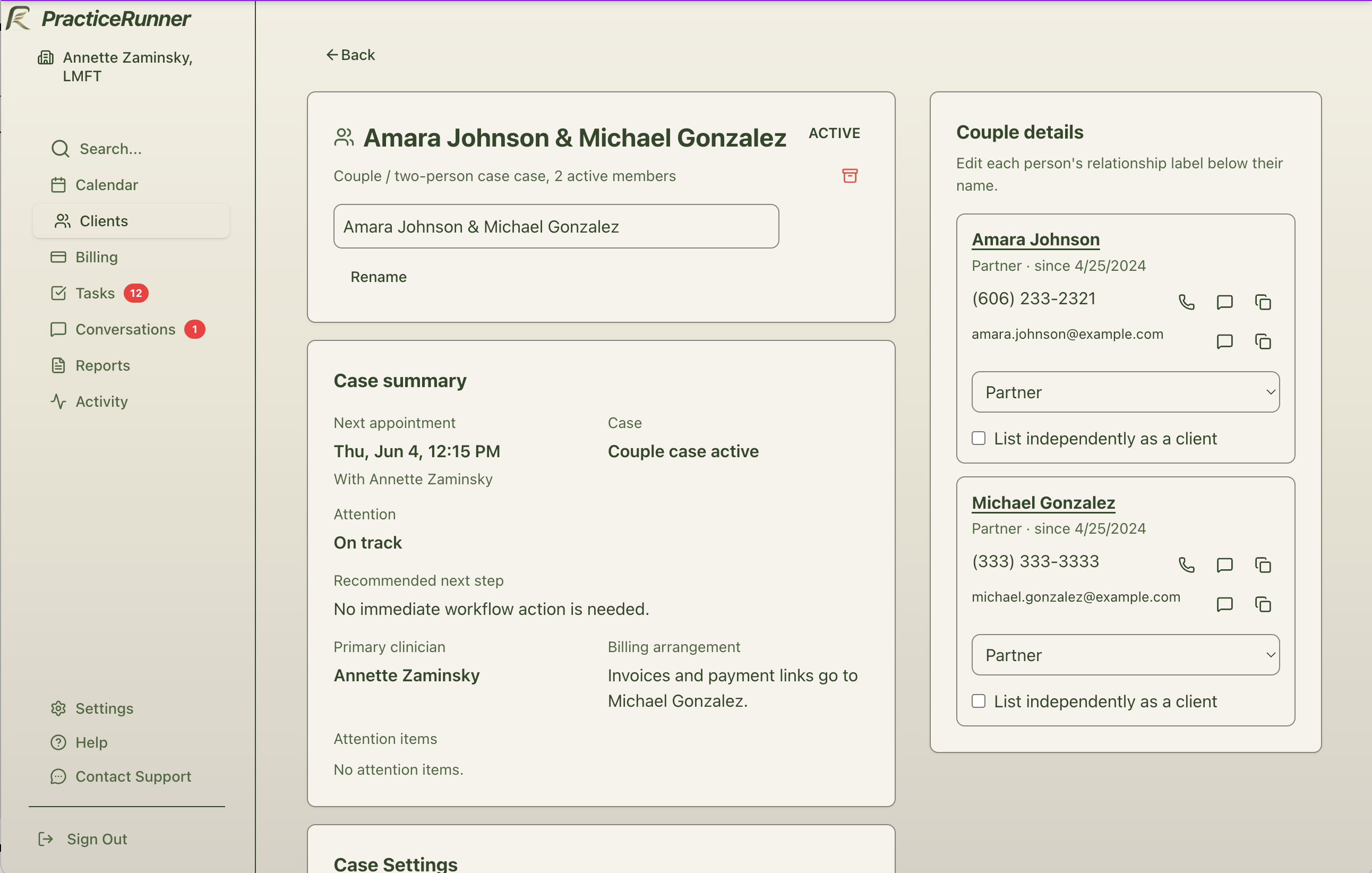
The case is the organizing unit, while participants, billing contacts, scheduling, documentation, and communication remain connected.
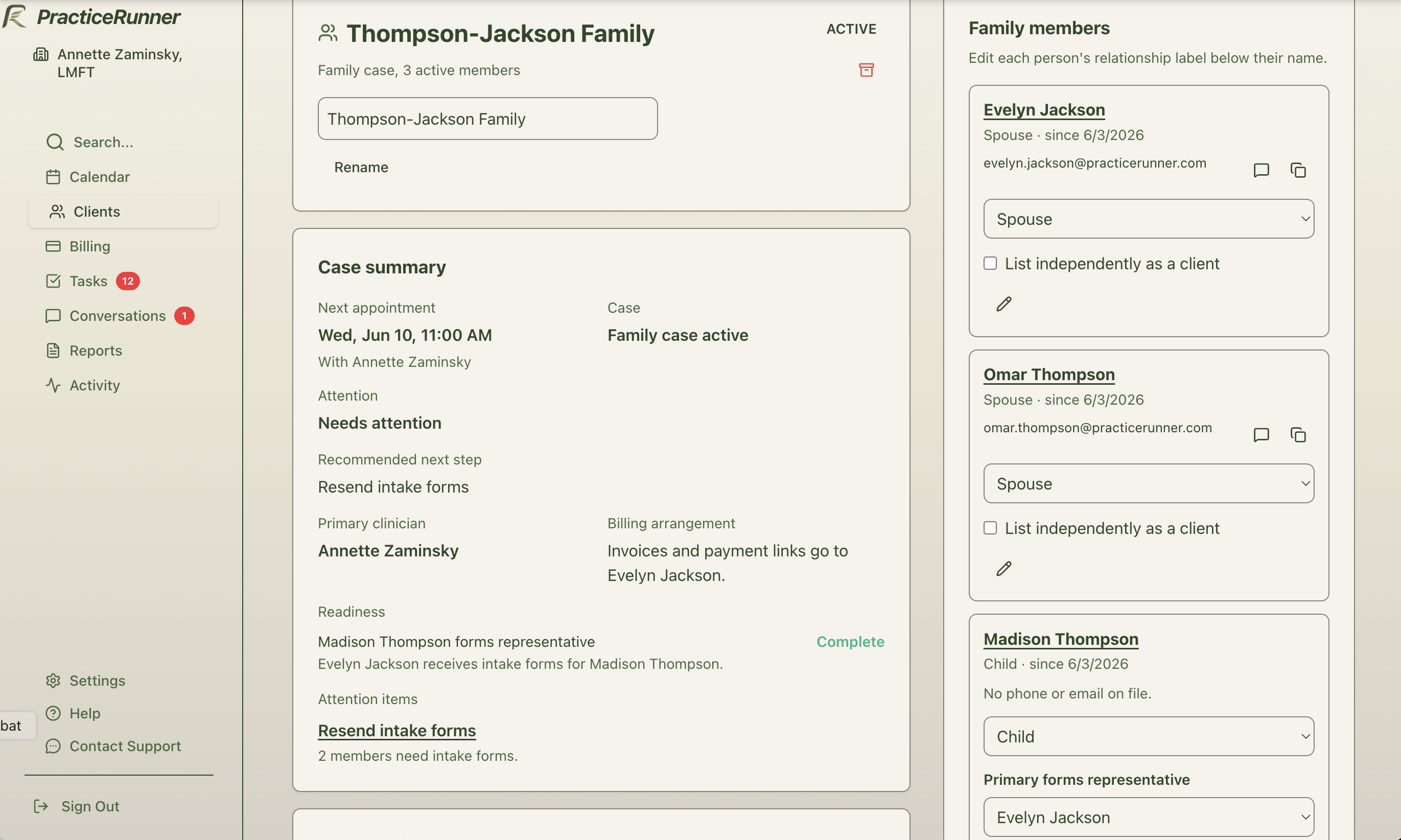
Couples, families, and groups can be organized around the relationship being treated, not forced into a single person's record.
How this differs from client-centered systems
Many systems can schedule a group appointment or attach multiple people to a session. That is useful, but it can still leave the core workflow centered on one person.
A case-based model starts from a different question:
Who or what is the case?
For individual therapy, the answer is usually one person. For couples, families, and groups, the answer is broader. The care belongs to the relationship or group structure, while each participant still keeps their own identity, contact information, and relevant responsibilities.
This helps avoid workarounds such as:
- choosing one partner as the owner of a couples case
- duplicating information across family members
- treating a group like a recurring appointment instead of a stable clinical structure
- losing track of who attends, who pays, and who receives communication
- mixing clinical responsibility with billing responsibility
Couples and two-person cases
In a two-person case, the work belongs to the pair.
PracticeRunner can keep the case connected to both people while still allowing the practice to track contact details, portal access, billing arrangements, appointments, notes, and scheduling around the shared clinical relationship.
This matters because the practical questions are rarely as simple as, "Which client owns this appointment?"
More often, the questions are:
- Who is participating in the work?
- Who should receive reminders or portal access?
- Who is responsible for payment?
- Which provider is responsible for the case?
- What does staff need to know before the next session?
Families and changing participation
Family work often changes over time.
A parent may attend one session alone. A child may join the next session. Another caregiver may become involved later. The clinical frame can stay stable even as participation changes.
With a case, the family can remain the organizing structure while participants and administrative responsibilities are handled more flexibly.
Groups and consultation
Groups and consultation services have their own workflow needs.
Participants may:
- join after the group begins
- leave before the group ends
- miss individual sessions
- need participant-level attendance tracking
- have different billing contacts or payment arrangements
A group should not have to be reduced to one person's client record. It also should not be treated only as a calendar event. A case gives the group a stable home for scheduling, attendance, communication, billing, and documentation.
Individual consultation uses the same case model for one consultation client. The consultation client is receiving professional consultation services, not psychotherapy, so the workflow emphasizes consultation appointments, invoices, receipts, messages, agreements, and consultation notes rather than diagnoses, insurance claims, treatment plans, or superbills.
Separate clinical, administrative, and billing responsibilities
The person receiving care is not always the person handling the administrative work.
Examples include:
- a parent paying for a child's treatment
- one partner handling payment for couples therapy
- a clinician paying for individual consultation
- a sponsoring organization paying for a consultation group
- an admin supporting scheduling or billing for a clinician
- a supervisor reviewing work performed by an associate
PracticeRunner is designed to keep these responsibilities clear instead of forcing them into one person’s record.
Why this matters as a practice grows
Many clinicians start with individual therapy, then add couples, families, groups, associates, admin support, or more complex billing arrangements.
A case-based model gives the practice room to grow without changing the basic mental model of the software. The same concepts can support a single client, a couple, a family, or a group while preserving the relational context of the work.